

Meet Exhibiting Artist, Eva During (Eva Ding)
In this interview, we speak with Eva During, recipient of The Arts House Trust & Dunedin School of Art Graduate Exhibition Scholarship 2025, about her journey retracing the paths of Aotearoa’s early Chinese immigrants along the Clutha River and how this experience shaped her artmaking. She reflects on belonging, memory, and the materials that speak through her hands—from indigo-dyed fabric to clay—revealing how personal stories can carry universal resonance.
Her solo show, Under the Bridge, is on view at The Arts House Trust 24 October - 18 January.

Multidisciplinary Artist, Eva During (Eva Ding)
You retraced the path of Aotearoa’s early Chinese immigrants along the Clutha River. What was that journey like for you, and how did it shape the work that followed?
It was indelible. Although there are only historical architectures left, the traces of their lived scene remain. It was a completely different experience while visiting these two sites.
The Lawrence Historical Chinese Mining Camp has Pan Fah ancestor hall peacefully sitting beside the highway; the noisier the highway is, the quieter the hall becomes. Empty, of course, yet through the window I see the renewed worship materials on the table, as well as the red Chinese couplets on each side of the main door, and the red Chinese lanterns hanging above. The first time I saw this, I was in awe, as if I had time-travelled back to my childhood, where these familiar elements filled in my memory. A nostalgia, I’d say, a yearning to reconnect to my own identity in Aotearoa New Zealand.
Visiting the Arrowtown Historic Chinese Mining Settlement was a different experience; it had brought me to the current making of shā bāo, where fallen leaves and branches became essential material transformed into the blueprints on fabrics. As these settlement huts are allowing visitors to walk in, I was instantly immersed in their lived scenes, as if I was picturing their thin quilts, worn-out shoes, and their spades and ropes laid before my eyes inside the empty huts. I could almost hear their after-work chats in Chinese while holding the rice bowl at dinner time.
I was born in China. My Childhood in the 90s was materially insufficient. Living in a crowded place with my family was a vivid memory stored in my childhood; I projected my memories, I guess, from my own perceptions. That’s how I felt I was connected immediately and deeply.
The proverb 落叶归根 (luò yè guī gēn) “fallen leaves return to their roots” speaks to belonging and return. How do you relate to this idea after twelve years in Aotearoa?
I think of their journey, more about those miners. They left China and came to Aotearoa because of the extreme poverty that struck a century and a half ago, seeking a job, really, and hoping to earn money to support their families and communities left behind. They laboured hard and were treated unequally under colonialism. Many of them died on this land, and their ashes were never able to return. Yes, I think of their experience, and many other first-generation immigrants, myself included.
In this old saying of 落叶归根 — “fallen leaves return to their roots” —, for me, it contains so much emotion one can hold for their homeland. People (Chinese) often say that no matter how far one travels, they shall return their deceased body to the homeland, to connect again with their roots. It’s more than a belief but a metaphor for belonging and connectedness.
As I sewed these ‘blueprinted’ fabrics into shā bāo, it had somehow become a way for me to converse with these miners across time and space; it also became a way to restore my childhood memories with my late grandma.
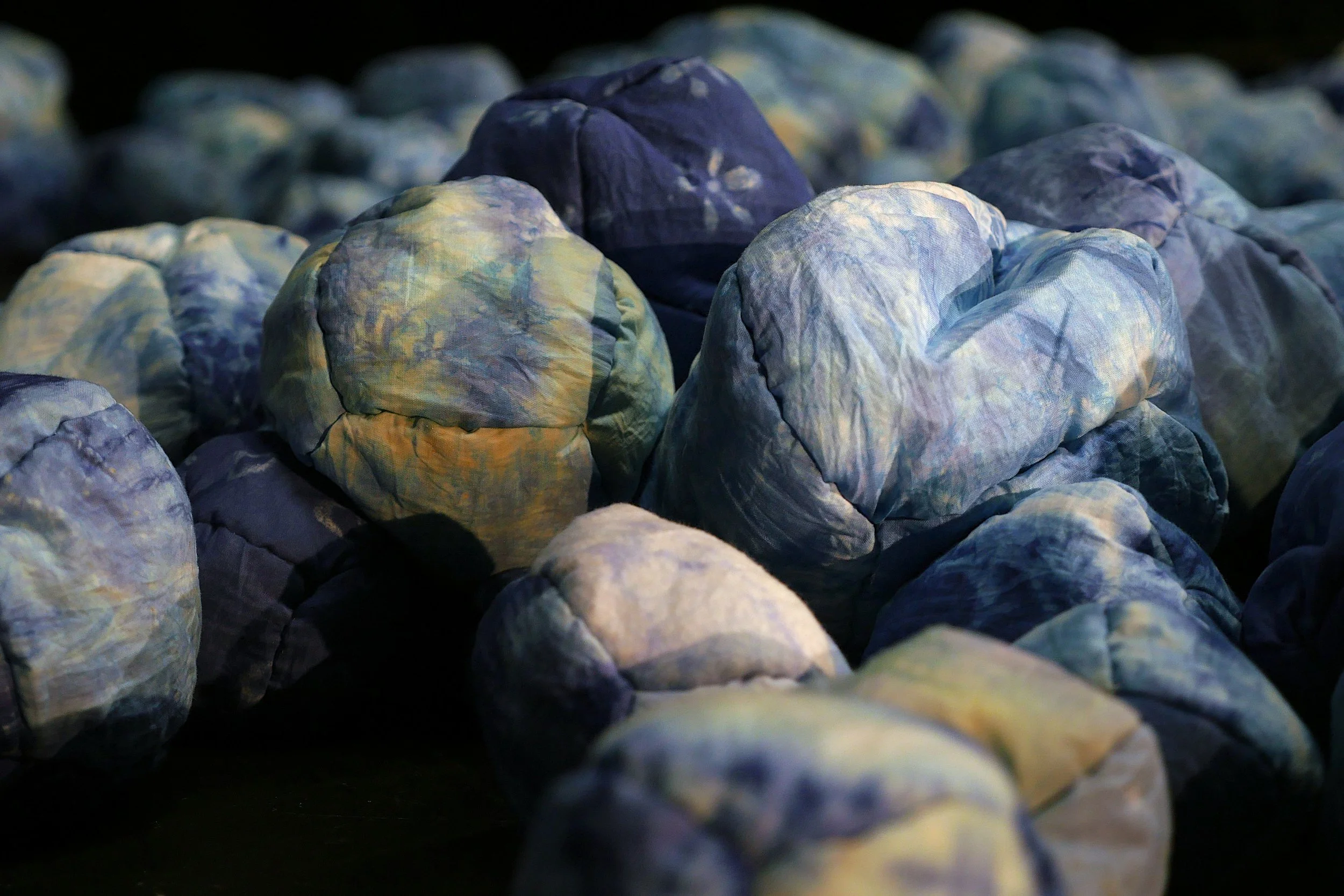
Hand-stitched shā bāo filled with wheat, grain, and bean, and digital media installation. Courtesy of the artist.
Can you tell us about the process of making the shā bāo? What does working in this way allow you to express?
It was a long story. When I was a child, I often played this game called ‘Diu shā bāo’ (Throwing shā bāo). Two kids stood on each side tossing a shā bāo to each other while another kid in the middle dodged. If you got hit, you were out. I remember once, someone’s shā bāo was filled with kidney beans, it hit my arm and left a deep bruise. I went home crying to my grandmother, angry and hurt. I begged her to make me a stronger shā bāo so I could hurt them back. She listened gently and said something like, “If it hurt so much when they hit you, then why would you want to hurt someone else just by imagining how painful it would be?” That moment stayed with me far longer than the bruise.
For me, these shā bāo became a ‘Choice’ of refusing to pass on the pain to others, that’s why I sewed hundreds of them, if they carry the weight that I could remember.
And I chose to make them lighter and softer. After I had tied fallen leaves and branches with fabric, and dyed them with indigo dye, I first quilted six pieces of square-cut fabric with inlay to make a cube, then turned it inside out, and filled it with beans, grains, and wheat. I guess it’s another layer of nostalgia, the indigo dye, with its simplicity and humbleness.
Adding inlay was almost like sewing a quilt. It directly connected me to memories of my grandma sewing. Under the Bridge started with this idea of sewing quilts that my grandma used to do in the traditional Chinese way in 2024. For me, those quilts she made were a shelter for her care and love. But I am not looking for a shelter anymore, I’ve made my ‘Choice’.
When I think of it now, I feel it was very much a personal story but somehow it reflects collective cultural memories. Maybe art is ultimately personal, as Carl Rogers had said, “What is most personal is most universal.”
Your practice spans multiple disciplines. How do you choose which materials or forms best express your intention?
I started my art journey in 2020 at Dunedin School of Art, majoring in ceramics. For me, clay has always had its way to create a direct connection with my body and emotions. After graduating with a Diploma in Ceramics two years later, I completed my final year of Bachelor of Visual Art in sculpture — that was when I began exploring some of the other materials, such as steel and papier-mâché. It was like, oh, so many potentials with different materials at that time. Hh! I then completed my Honours in sculpture, practising in traditional Chinese paper-cut. And now I am sewing with fabrics!
It is only through this journey of exploring that my understanding of the relationship between the materials I choose and myself has deepened over time. Materials are the agencies that speak for sculptors in their artworks. If one material cannot speak profoundly, I try another until I find the connections. This connection is the most important thing to me. Sometimes I’m lucky, knowing exactly what material I need for a project. More often than not, I choose the wrong material at the beginning of my project, and it’s okay. When I feel disconnected in expressing through it, I step back, reassess my thoughts, until I find the one that feels right.
Recently, I have come back to the clay medium and have made a few ceramic pieces, one of which was selected for the Ceramics NZ 61st National Exhibition, and another work was chosen for the Portage Ceramic Awards this year. Thrilled, and feeling humbled. The journey of art is long, and I am in it, discovering possibilities, experiencing each tomorrow, even just within clay itself, my perspective of seeing my relationship with the medium is continuously transforming.
As recipient of The Arts House Trust & Dunedin School of Art Graduate Exhibition Scholarship, how has this opportunity shaped your direction as an artist?
Really appreciate this opportunity to be the recipient of The Arts House Trust & Dunedin School of Art Graduate Exhibition Scholarship. It has been an excellent opportunity to be able to exhibit my artwork in Auckland at The Arts House Trust, Pah Homestead.
It is always challenging for emerging artists to enter the art industry, especially for those who have just graduated from their Honours or Bachelor’s degree. I feel so lucky!
From starting the proposal in 2024 to completing the work, I have received so much help and support from the Dunedin School of Art, the OP Education Foundation and The AHT. My supervisors, Scott Eady, Ed Hanfling and David Green, have provided critical insights and guidance throughout the year and a half. Conversations with Nicholas Butler (Curator at The Arts House) had encouraged me to engage with galleries and curators professionally as an artist and to build a meaningful relationship.